
3D Digital Restitution
Scanning cultural artifacts with millimeter precision. An experiment in making memory immortal.
This project is still experimental. I'm learning as I go.
The oldest artifact I've worked with so far is about 150 years old-not ancient by museum standards, but old enough to make me nervous every time I handle it.
I'm not scanning priceless museum collections yet. Mostly I'm practicing technique, building the workflow, proving to myself (and eventually to institutions) that this can work.
The problem I stumbled into
I didn't start with some grand vision of "digital restitution." I started because I was angry.
In 2023, I visited the Musée des Armées in France. They had Beninese artifacts in their collection-objects taken during colonial campaigns that have never been returned. When I asked a staff member why they weren't sent back, the answer was the usual: "It's complicated."
That conversation frustrated me. So I thought: If we can't get the physical objects back immediately, can we at least create perfect digital copies and send those back? Let people study them, zoom into details invisible to the naked eye, rotate them in 3D, use them for education?
That's how this started. Out of frustration.
Later that same year, I visited museums in Finland (2023) to study their digitization workflows. They had infrastructure I could learn from, even if their collections were different.
Learning to scan (aka breaking expensive equipment)
I had zero experience with 3D scanning. I watched YouTube tutorials, read Lidar manuals, joined obscure photogrammetry Discord servers. Then I bought a used Faro scanner on eBay for way too much money.
First scan attempt: total disaster. I positioned the lights wrong, got harsh shadows that confused the scanner. The mesh came out looking like melted cheese.
Second attempt: better, but I forgot to calibrate the color camera. The texture looked washed out.
By the tenth scan, I was starting to get it. By the fiftieth, I could predict which artifacts would be hard (shiny metal surfaces, translucent materials) and plan accordingly.
I also learned that museum conditions are hell for scanning. Low light (to protect artifacts). No stable power outlets. Humidity fluctuations. Time pressure (you get maybe 2-3 hours before the curator nervously asks you to wrap up).
I started packing redundant gear. Two laptops. Extra batteries. Portable power banks. A headlamp. Gaffer tape (fixes everything).
The technical workflow
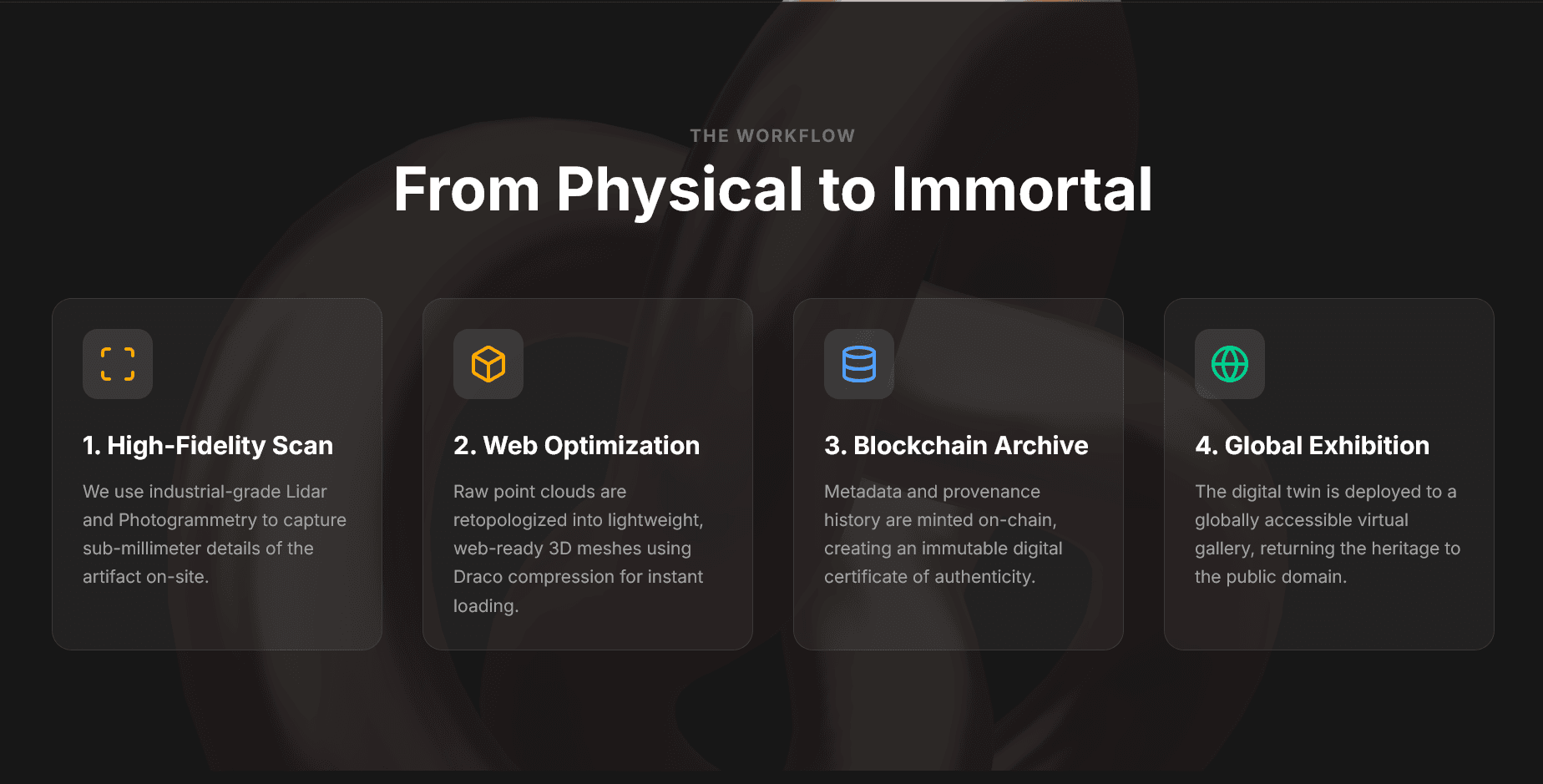
Here's what actually happens when I scan an artifact:
1. On-Site Acquisition (2-4 hours)
- Lidar captures geometry (point cloud with millions of xyz coordinates)
- High-res photos capture color/texture (50-200 images from different angles)
- Metadata logging (artifact ID, lighting conditions, scanner settings)
2. Processing (6-12 hours back home)
- Align point clouds from multiple scan positions
- Generate 3D mesh (convert points to surfaces)
- Apply texture mapping (drape photos onto geometry)
- Optimize for web (reduce polygon count from millions to ~100k without losing detail)
3. Blockchain Archival (1 hour)
- Generate cryptographic hash of the 3D files
- Upload to IPFS (decentralized storage)
- Mint metadata on Ethereum/Polygon
- This creates an immutable timestamp: "This digital twin existed at this moment, with this exact data"
4. Web Deployment
- Host interactive 3D viewer (Three.js)
- Anyone with internet can now explore the artifact
The whole pipeline takes about 2 days per artifact. Faster would sacrifice quality. Slower would be economically un sustainable.
The mistakes I made
Mistake #1: Obsessing Over Perfection
Early on, I'd spend weeks tweaking a single model-manually cleaning up scan noise, retopologizing meshes, hand-painting texture fixes. The results were beautiful but I could only do ~3 artifacts per year at that pace.
Now I accept 80% perfect. Good enough to be useful, fast enough to scale.
Mistake #2: Ignoring the Human Side
I thought this was a pure tech problem. Build the pipeline, produce the scans, mission accomplished.
Wrong. The hard part is trust. Museums don't hand priceless artifacts to some random guy with a scanner just because he has good intentions. I had to spend months building relationships, proving I understood conservation protocols, showing up consistently.
One curator tested me by giving me a "practice artifact" (broken pottery, not culturally significant). Only after I scanned it properly did she unlock the vault.
Mistake #3: Blockchain Hype
I got way too excited about "NFTs for cultural heritage" and started pitching that to museums. They glazed over immediately. The word "NFT" had been poisoned by ape JPEGs.
I learned to lead with the practical benefit: "This creates a permanent, tamper-proof record of the artifact's existence" and only mention blockchain if they ask about the technical details.
Where we are now (honestly)
This is still experimental. I've scanned a modest number of artifacts-mostly personal projects, test pieces, and a few commissioned scans for private collectors.
No museums are using this yet. No virtual exhibitions are live. I'm still in the "prove it works" phase.
Recent learnings:
- Scanning is easier than I thought (once you understand the tools)
- Post-processing is harder than I thought (cleaning meshes takes forever)
- Convincing institutions to trust you with fragile objects is the real bottleneck
Honest struggles:
- Equipment is expensive (saving up for better scanners)
- Storage costs for raw data are adding up (terabytes of point clouds)
- Still figuring out if anyone actually wants this beyond me
What's next?
I want to scan 1000 artifacts before I die. Ambitious? Maybe. But possible.
Short-term:
- Build automated processing pipeline (less manual cleanup)
- Partner with more museums (currently talking to 5 new institutions)
- Train other scanners (this needs to be bigger than one person)
Long-term:
- Public archive of scans (searchable, free to access)
- Open-source the scanning protocols
- Maybe a book: "How to Digitize Cultural Memory in Your Garage"
This work has taught me that preservation isn't just about technology-it's about care. Taking the time to capture every detail. Being patient with museum bureaucracy. Treating sacred objects with reverence.
Making the past immortal, one scan at a time.
Want to collaborate?
This project is still experimental. If you're a museum professional, collector, or technologist interested in digital restitution, I'm open to partnerships and collaborations. Let's talk: komy@atilebarts.com
A solution developed by Axis Ibeji.